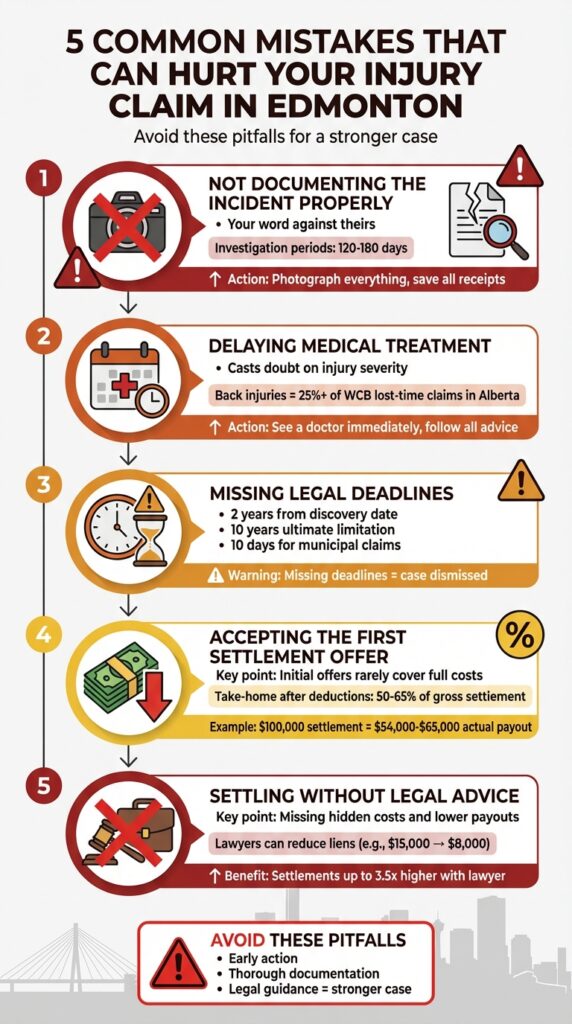
5 Common Mistakes That Can Ruin Your Injury Claim in Edmonton
When you are dealing with the aftermath of an accident, the legal process can feel like a secondary trauma. For those seeking Edmonton injury lawyers, the goal is simple: secure the compensation needed to recover. However, even the strongest cases can be undermined by simple oversights.
In Alberta, the path to a fair settlement is paved with strict deadlines and evidentiary requirements. From missing statutory timelines to accepting lowball initial offers, certain missteps can reduce your payout or void your claim entirely.
Below are the five most common mistakes victims make and how you can avoid them to protect your future.
1. Failing to Properly Document the Accident
One of the most frequent errors seen by injury lawyers in Edmonton is a lack of contemporaneous evidence. Without a paper trail, your claim becomes a “he-said, she-said” scenario, which insurance adjusters will use to deny liability.
How to document correctly:
Visual Evidence: Use your phone to photograph the hazard (ice, a broken stair, or vehicle positioning), your visible injuries, and any property damage.
The “Paper” Trail: The City of Edmonton specifically advises claimants to retain all receipts for expenses incurred due to the injury. This includes medications, physiotherapy, and even hospital parking.
Keep a Journal: Record your pain levels and how the injury impacts your daily life. This helps your legal team calculate “Loss of Enjoyment of Life” damages.
2. Delaying Medical Treatment or Ignoring Orders
You might feel fine or just a bit stiff immediately after an accident due to adrenaline. However, delaying a medical exam is a critical mistake. If you wait two weeks to see a doctor, the insurance company will argue that your injury happened elsewhere or isn’t as severe as you claim.
Expert Insight: The severity of your documented injuries is the primary factor in determining your settlement value. If it isn’t in a medical record, legally, it didn’t happen.
Consistency is also key. If a specialist prescribes physiotherapy and you skip sessions, the defence will argue you are failing to mitigate your damages. To maximize your claim, follow every doctor’s note to the letter.
3. Missing Deadlines Under the Alberta Limitations Act
Time is your greatest enemy in a Personal Injury case. Under the Alberta Limitations Act, you generally have two years from the discovery date to file a formal lawsuit. However, there are much shorter windows you must be aware of:
Municipal Claims: If your injury involved City of Edmonton property (like a sidewalk or transit), you must often provide written notice within 7-30 days.
The Discovery Rule: The clock usually starts when you knew, or should have known, that you were injured and that someone else was at fault.
If you miss these windows, your right to sue can be permanently extinguished. Consult Edmonton injury lawyers immediately after an accident to make sure your filings are prioritized.
4. Accepting the First “Quick” Settlement Offer
Insurance companies are businesses focused on profit. They often reach out to victims shortly after an accident with a preliminary offer. While a quick check might seem tempting when bills are piling up, these offers rarely cover the long-term reality of an injury.
Why you should wait:
The 50% Reality: After lawyer fees, case expenses, and medical liens are deducted, a $100,000 settlement might only put $55,000 in your pocket. An early, smaller offer might leave you with almost nothing.
Future Costs: You may require surgery or chronic pain management years down the road. Once you sign a release, you cannot go back for more money if your condition worsens.
Maximum Medical Improvement (MMI): You should never settle until a doctor confirms you have reached MMI, ensuring all future needs are accounted for.
5. Attempting to Settle Without Legal Advice
Many people believe they can save money by handling their own claim. In reality, unrepresented claimants typically receive significantly lower settlements.
Edmonton injury lawyers provide value far beyond just filing papers. A skilled firm like Martin G. Schulz & Associates can:
Negotiate Liens: If Alberta Health Services or a private insurer has a lien on your settlement, a lawyer can often negotiate these down, putting more of the final total in your pocket.
Level the Playing Field: Insurance adjusters are professional negotiators. Having a lawyer shows them you are prepared to go to trial if they don’t offer a fair amount.
Expert Witnesses: Lawyers have access to medical experts and accident reconstructionists who can prove the full extent of your damages.
How Martin G. Schulz & Associates Protects Your Claim
Navigating the legal landscape in Alberta is complex. Since 1990, Martin G. Schulz & Associates has served as a dedicated advocate for accident victims, securing over $100 million in damages for more than 7,000 clients.
With a 99% success rate in prosecuted cases, our team handles the heavy lifting, from managing the 180-day investigation periods to filing documents under the Limitations Act. We operate on a contingency fee basis, meaning you don’t pay unless we win.
“Martin was there right away from the beginning. He was knowledgeable about the law and for the things I was eligible for.” – Matt, Edmonton Client
Why should I choose Martin G. Schulz & Associates?
With over 30 years of experience specifically as Edmonton injury lawyers, we provide the resources of a large firm with the personal touch of a boutique practice. We cover all upfront costs, taking care of the legal process so that you can focus on healing.
Don’t let a simple mistake cost you your future. Contact Martin G. Schulz & Associates today for a free, no-obligation consultation.
Generally, the Limitations Act in Alberta gives you a 2-year timelinThe discovery date is the day you first realized (or should have reasonably realized) that you were injured and that another party was responsible. In Alberta, this date typically triggers the two-year countdown to file a claim.e from the date of the accident to file a lawsuit. Missing this window means you lose your right to both settlement and trial.
If you lose at trial, you receive $0. Under a contingency model, you would not owe legal fees, but you might be responsible for the "taxable costs" of the winning side. This is why we only recommend trial when the evidence is robust.